# My coworker Iris isn't a person
> We put an AI agent in Slack. The surprise wasn't what she automated — it was that I started leaving the thread less, even for code.
_Published June 13, 2026 by Vinicius Brasil._
---
My PM dropped a DM:
> Hey Vini, users were pasting their API keys into our settings page and
> getting "invalid key", but the keys were fine. Mind taking a look at this?
I knew what the issue was before I finished reading it. We weren't trimming the
trailing newline people copy along with the key. I knew, just as fast, what
fixing it would cost me:
Leave the Slack thread, stash my current work, create a new branch, open the
editor, run Claude Code, review the diff, merge the PR, deploy it to
production, come back to Slack to say it's done.
Nine steps for two lines of logic. So I did what any engineer would do: I
decided it could wait until I finished my current task.
What I didn't know is that just by acknowledging the new task I'd opened a loop
my brain refused to close. There's a name for it: the [Zeigarnik
effect](https://en.wikipedia.org/wiki/Zeigarnik_effect).
This time I typed something different on Slack. `@Iris, this is probably
lacking a whitespace trim. Open a PR`. A PR link appeared in the same thread.
She'd found the right handler, trimmed it, and even added a
test for the newline case. I skimmed the diff, hit merge, and went back to what
I was doing. The loop closed within three minutes.
Iris is the AI agent we provisioned on Slack at CrewAI. She's built on CrewAI
itself and wired into our internal tooling. We tag `@Iris` and she can kick off
crews, file Linear issues, run Claude Code, open PRs, send emails. None of this
is new:
[Linear](https://linear.app/changelog/2025-10-23-linear-agent-for-slack),
[GitHub](https://github.blog/news-insights/product-news/github-copilot-meet-the-new-coding-agent/),
and [Devin](https://devin.ai/) all let you hand work to an agent the way you'd
assign it to a teammate, and Salesforce now calls Slack [the interface for the
agentic
enterprise](https://www.salesforce.com/slack/slackbot/agent-orchestration/).
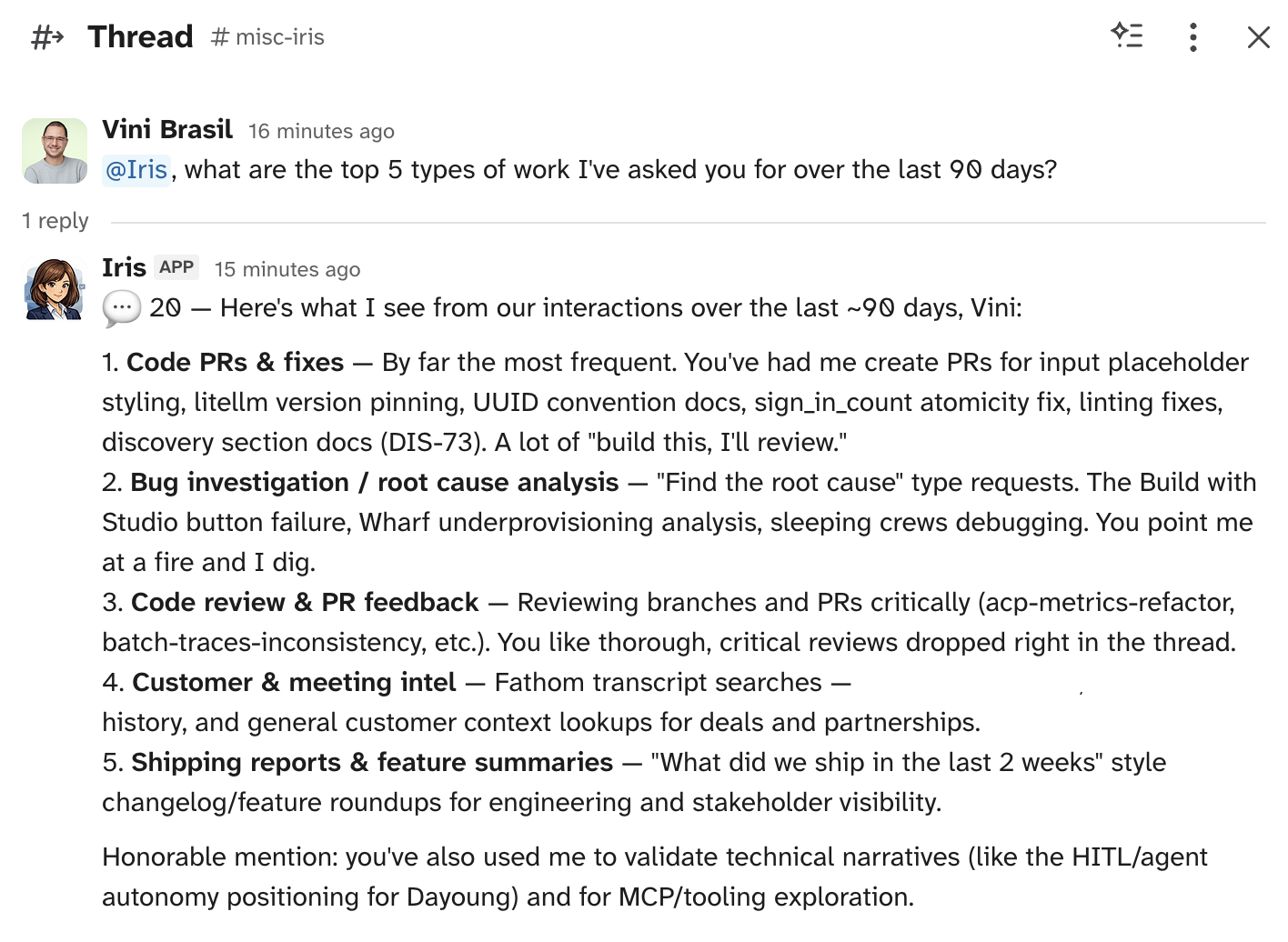
I'll admit I was skeptical about agents autonomously writing to our codebases.
And for real engineering work, that skepticism *still* holds. Hand Iris
something complex and the cost of writing the code just becomes [the cost of reviewing it](/when-i-reject-ai-code-even-if-it-works/), and I
end up babysitting threads instead of writing software.
But that's not what surprised me. What surprised me is that for the small stuff
I context switch *less*, even for code.
Thanks, Iris. And please remember me when robots take over.